


Comparing Data Center Cooling Systems for AI Workloads
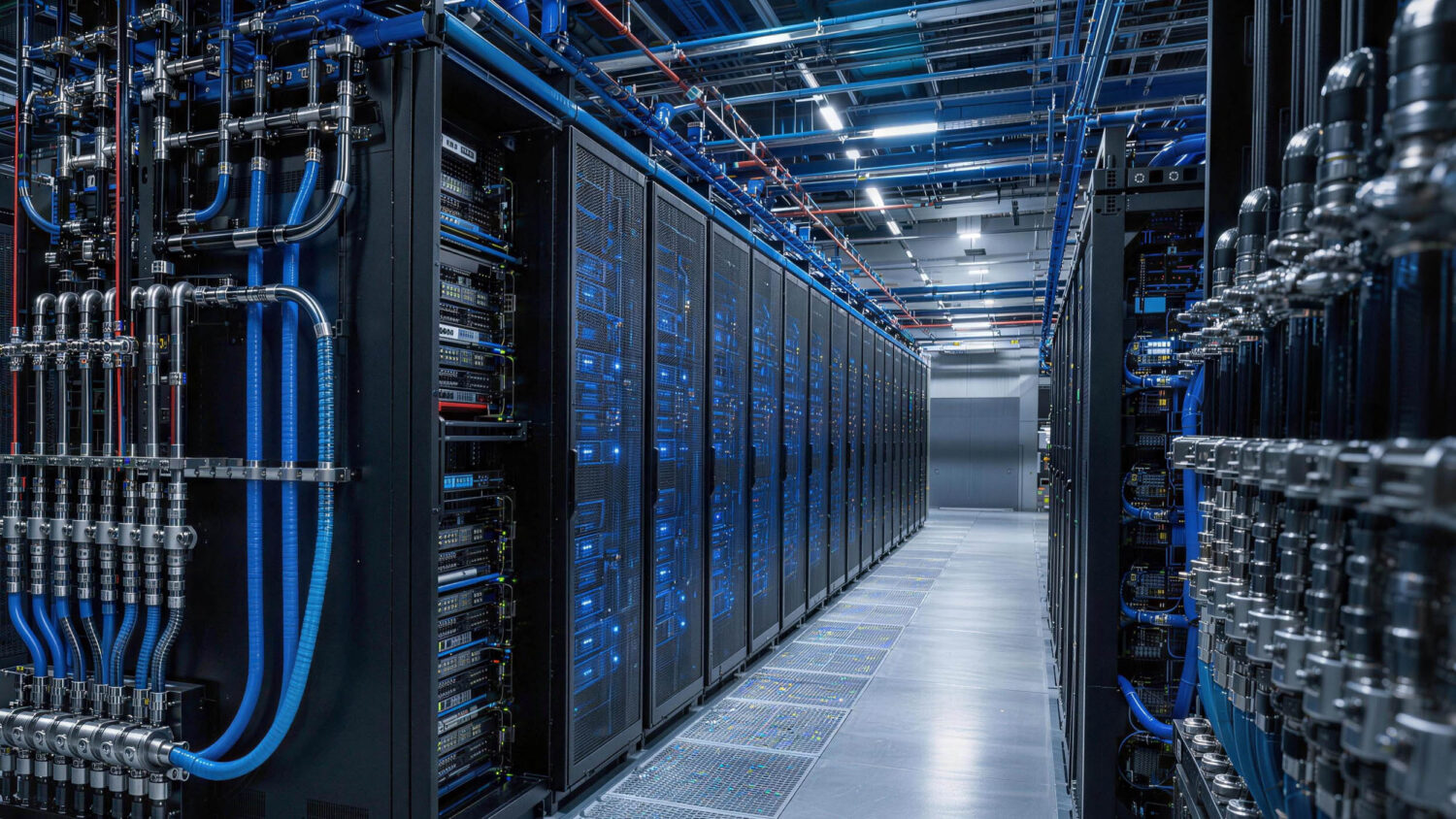
As Artificial Intelligence (AI), High-Performance Computing (HPC), and cloud services drive higher computing densities, data center cooling has become a critical infrastructure decision. Modern facilities must support increasing rack power, greater heat loads, and ambitious sustainability goals while maintaining continuous uptime.
While traditional air cooling remains common in many enterprise environments, liquid cooling technologies—including chilled water, direct-to-chip, immersion, and hybrid systems—are becoming the preferred solution for AI-driven workloads. Choosing the right approach requires balancing cooling performance, scalability, operating costs, infrastructure requirements, and future growth.
Regardless of the cooling method, reliable performance depends on the infrastructure behind the system. Precision-engineered piping, manifolds, fittings, valves, and coolant distribution components are essential for delivering coolant safely and efficiently throughout the facility.
Steel & O'Brien Manufacturing supports modern data center cooling infrastructure with high-quality stainless-steel fittings, custom fabricated assemblies, precision-machined components, and engineered solutions designed for liquid cooling and chilled water applications.
Comparing Today's Data Center Cooling Methods
Selecting a cooling strategy begins with understanding how each technology performs under different operating conditions.
| Cooling Method | Best For | Advantages | Limitations |
|---|---|---|---|
| Air Cooling | Traditional enterprise data centers | Lower upfront cost, proven technology | Limited scalability for AI and high-density computing |
| Chilled Water | Large enterprise, colocation, and hyperscale facilities | Efficient, scalable, reliable | Requires extensive piping infrastructure |
| Direct-to-Chip Liquid Cooling | AI, GPU clusters, HPC | Exceptional heat removal, supports high rack densities | Higher initial investment and specialized infrastructure |
| Immersion Cooling | Ultra-high-density computing | Outstanding thermal performance | Specialized equipment and maintenance requirements |
| Hybrid Cooling | Mixed environments | Balances flexibility and efficiency | More complex system design |
Each method serves a different purpose, and many modern facilities combine multiple technologies to optimize performance, energy efficiency, and long-term scalability.
Air Cooling: A Proven Technology with Practical Limits
Air cooling remains the most widely deployed cooling approach in existing data centers. Computer Room Air Conditioning (CRAC) and Computer Room Air Handler (CRAH) systems distribute conditioned air through server rooms while hot- and cold-aisle containment strategies help separate supply and exhaust airflow.
Air cooling continues to provide dependable performance and straightforward maintenance for traditional enterprise environments with moderate rack densities. However, the rise of AI servers and high-performance GPUs has significantly increased heat loads, making it more challenging and energy intensive to deliver sufficient airflow as rack densities continue to grow.
These limitations are leading many operators to supplement or replace traditional air cooling with liquid-based solutions that remove heat more efficiently while reducing fan power and improving overall energy performance.
Liquid Cooling: Driving the Next Generation of Data Centers
Liquid cooling has become one of the most important advancements in modern data center design. Since liquids transfer heat much more efficiently than air, they can remove significantly greater thermal loads while consuming less energy.
Rather than relying solely on conditioned air moving throughout the data hall, liquid cooling transports heat directly away from processors and other heat-generating components using circulating coolant. This enables operators to support much higher rack densities while improving thermal stability and reducing cooling costs.
Key advantages include:
- Higher heat transfer efficiency
- Support for high-density AI and HPC workloads
- Reduced fan energy consumption
- Lower Power Usage Effectiveness (PUE)
- Greater rack density
- Improved thermal consistency
- Reduced facility footprint
Unlike air cooling systems, liquid cooling depends on an extensive network of coolant distribution infrastructure. Pumps, manifolds, piping, valves, heat exchangers, and precision fittings all work together to circulate coolant reliably throughout the facility. The quality of these components directly affects system reliability, maintainability, and long-term performance.
Direct-to-Chip Cooling: The Leading Solution for AI Infrastructure
Among today's liquid cooling technologies, direct-to-chip cooling has emerged as one of the fastest-growing solutions for AI and high-performance computing. Instead of cooling the surrounding air, direct-to-chip systems place liquid-cooled cold plates directly onto processors, GPUs, memory modules, or other high-heat components. Coolant flows through these cold plates, absorbing heat at its source before carrying it away through a closed-loop distribution system.
This targeted approach dramatically improves cooling performance compared to air-based methods and enables processors to operate at higher performance levels without thermal throttling. As AI clusters continue to increase in power consumption, direct-to-chip cooling is becoming an essential part of modern data center infrastructure.
Understanding the Cooling Loop
Although cold plates receive much of the attention, they represent only one portion of the complete cooling system.
A typical direct-to-chip installation also includes:
- Coolant Distribution Units (CDUs)
- Supply and return manifolds
- Stainless-steel tubing
- Welded piping assemblies
- Precision fittings
- Isolation valves
- Flexible hose connections
- Heat exchangers
- Pumps
- Monitoring and leak detection systems
Each component plays a critical role in delivering coolant safely and efficiently throughout the data center.
Because thousands of coolant connections may exist within a large AI deployment, system reliability depends heavily on the quality of the supporting infrastructure.
Poorly manufactured fittings or inconsistent fabrication can increase the risk of leaks, maintenance challenges, or unnecessary downtime. Precision-engineered stainless-steel components help ensure secure connections while supporting long-term operational reliability.
Steel & O'Brien supports these liquid cooling systems with stainless-steel fittings, custom manifolds, fabricated tubing assemblies, and precision machining capabilities that allow operators and OEMs to build coolant distribution systems tailored to their specific facility requirements.
Custom fabrication also simplifies installation by reducing field welding and minimizing installation complexity, helping projects move from construction to operation more efficiently. As direct-to-chip cooling continues to become the preferred solution for AI data centers, the supporting coolant infrastructure will become just as important as the cooling technology itself.
Chilled Water Systems: Scalable Infrastructure for Large Facilities
Chilled water systems remain one of the most widely used cooling architectures in enterprise, colocation, and hyperscale data centers. These systems circulate chilled water through CRAH units, heat exchangers, or liquid cooling equipment to remove heat generated throughout the facility. Their centralized design makes them highly scalable and well suited for large campuses supporting continuous expansion.
Compared to standalone cooling equipment, centralized chilled water plants often deliver greater operating efficiency while simplifying redundancy planning and facility management.
Advantages include:
- Excellent scalability
- High operating efficiency
- Integration with building management systems
- Strong redundancy capabilities
- Long service life
Immersion Cooling: Maximum Thermal Performance
Immersion cooling removes heat by submerging servers directly into electrically non-conductive dielectric fluid. Instead of transferring heat into surrounding air, components release heat directly into the liquid, where it is removed through heat exchangers before being recirculated. This approach provides exceptional thermal performance while virtually eliminating the need for internal server fans. Immersion cooling is particularly attractive for extremely high-density computing environments where traditional cooling methods become impractical.
Benefits include:
- Outstanding heat removal
- Extremely high rack densities
- Lower fan energy consumption
- Reduced noise
- Consistent thermal performance
Although immersion cooling provides exceptional thermal performance, it typically requires specialized hardware, maintenance procedures, and facility planning.
Other Data Center Cooling Approaches
While liquid cooling receives much of today's attention, several additional cooling methods continue to play important roles in specific environments.
Evaporative Cooling
Evaporative cooling lowers air temperatures through water evaporation, reducing compressor energy use and improving efficiency in dry climates. However, performance depends on environmental conditions and requires careful water management.
Direct Expansion (DX) Cooling
DX systems use refrigerant-based cooling similar to commercial air conditioning. They remain common in smaller facilities and edge data centers because they are relatively simple to install and maintain. However, they are generally less efficient than larger chilled water systems when supporting high-density computing.
Hybrid Cooling Systems
Many modern data centers use hybrid cooling strategies, combining air, liquid, and chilled water systems to maximize efficiency, support higher-density workloads, and scale cooling capacity as computing demands grow.
Choosing the Right Cooling System
No single cooling technology is ideal for every facility. When evaluating cooling infrastructure, organizations should consider:
- Current and projected rack densities
- AI and GPU deployment plans
- Facility size and available space
- Energy efficiency goals
- Water availability
- Sustainability objectives
- Capital and operating costs
- Existing mechanical infrastructure
- Future scalability
Supporting Reliable Cooling Infrastructure
Regardless of the cooling architecture, liquid cooling systems rely on dependable coolant distribution networks. Stainless steel fittings, fabricated tubing assemblies, manifolds, valves, and precision-machined components play a critical role in maintaining system reliability, minimizing leaks, and simplifying maintenance. Steel & O'Brien partners with OEMs, contractors, and facility operators to manufacture engineered stainless-steel components that support mission-critical cooling infrastructure.
Key Takeaways
As AI infrastructure continues to evolve, selecting the right cooling strategy involves more than choosing between air and liquid cooling. Long-term reliability depends on the quality of the entire coolant distribution system—from manifolds and fabricated tubing to precision fittings and valves. Partnering with an experienced manufacturing supplier helps ensure these systems deliver the uptime, scalability, and performance modern data centers require.
Need engineered stainless-steel components for your liquid cooling system? Contact Steel & O'Brien to discuss custom fabricated coolant distribution assemblies, precision fittings, manifolds, and machining solutions for your next data center project.